All storiesHollin · No. 14, Salt
Essays
What the tide leaves
Twice a day the sea writes a line along the beach and then rubs it out. An essay on walking the strandline, and on the things we only notice once they're washed up.
Words by Sam Ashby2 min read
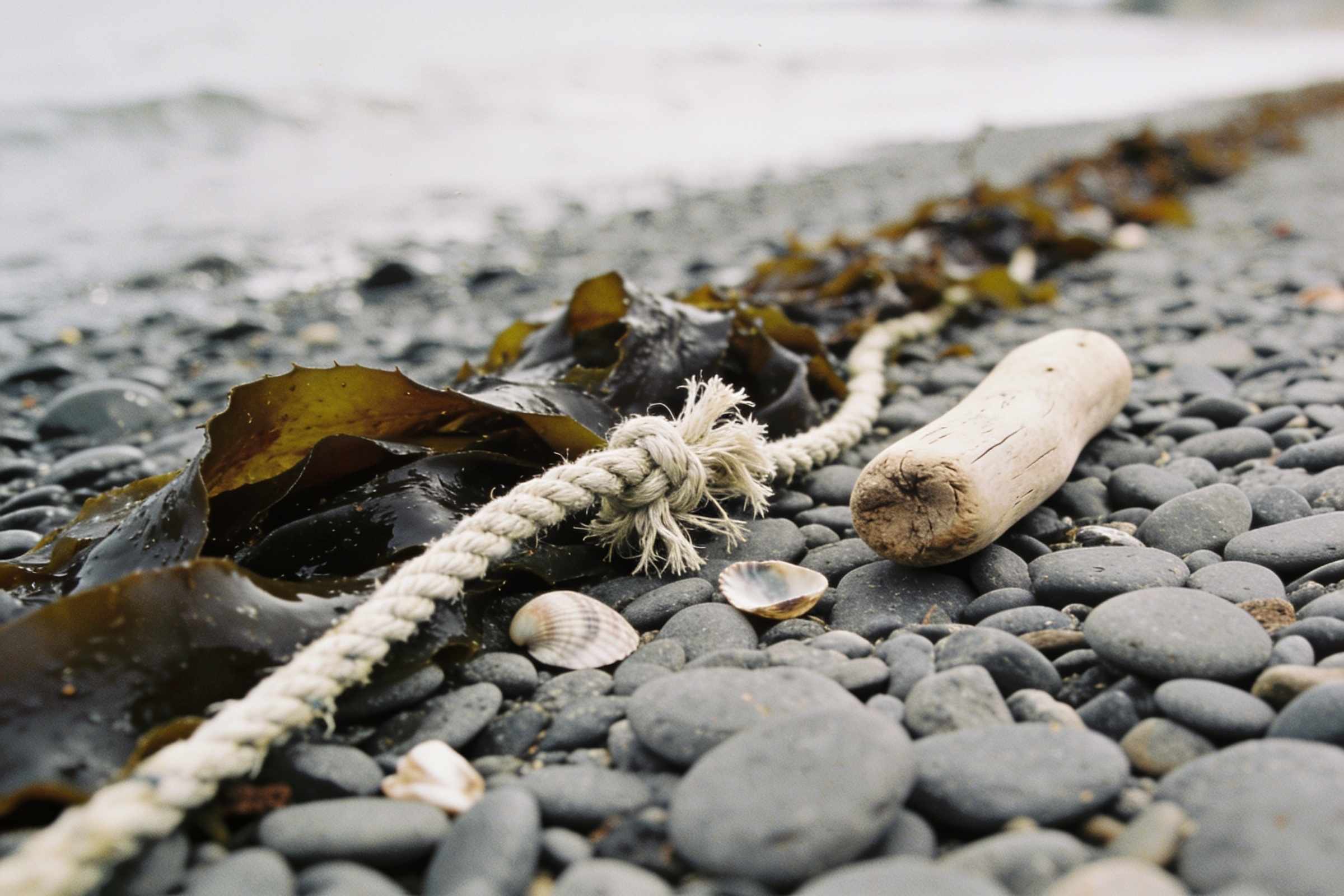
I walk the strandline most mornings, the way other people check the news. It’s the same beach every day and never the same beach twice: the tide comes in, draws a careful line of everything it carried, then goes out and leaves it for whoever comes first. Usually that’s the gulls. Sometimes it’s me.
What it leaves is mostly kelp, black and rubbery and smelling of iodine. Then the smaller things, sorted by the water into an order that looks almost deliberate: the light things at the top, feathers and dried wrack and the papery egg cases of skates; the heavier things lower down, shells and pebbles and, after a storm, whole branches stripped white.
The rope
And rope. There is always rope. Frayed blue nylon from the fishing boats, a length of orange twine, once a whole coil of old hemp, grey and soft as wool, that must have been in the water for years. I took that one home. It’s on the shelf above my desk and it still smells faintly of the sea, which I think is the most I can ask of an object.
The strandline is the sea’s way of telling you what it has been up to, in a language made entirely of things.
People who walk beaches for treasure tend to look down. I’ve learned to look sideways along the line instead, the whole length of it, the way you’d read a sentence. Where it thickens, a current has been at work. Where it breaks, a stream crosses the sand. A line of tiny shells, all the same kind, is a bed of them somewhere out of sight, dying or being torn up. The tide is not tidy, but it is precise.
There’s a kind of patience you learn from a coast that you don’t learn anywhere else. The line will be different tomorrow whatever you do. The things you didn’t pick up will be gone or buried, and other things will be there instead. It is a daily lesson in letting go, and I am still, after eleven years, not very good at it. I have a shelf full of rope to prove it.
End of story.