All storiesHollin · No. 14, Salt
Craft
A short history of the salt cellar
For centuries the dish that held the salt told everyone at the table exactly where they stood. Then it shrank, got a lid and disappeared into the shaker. A small object, and a long story.
Words by Owen Hale3 min read
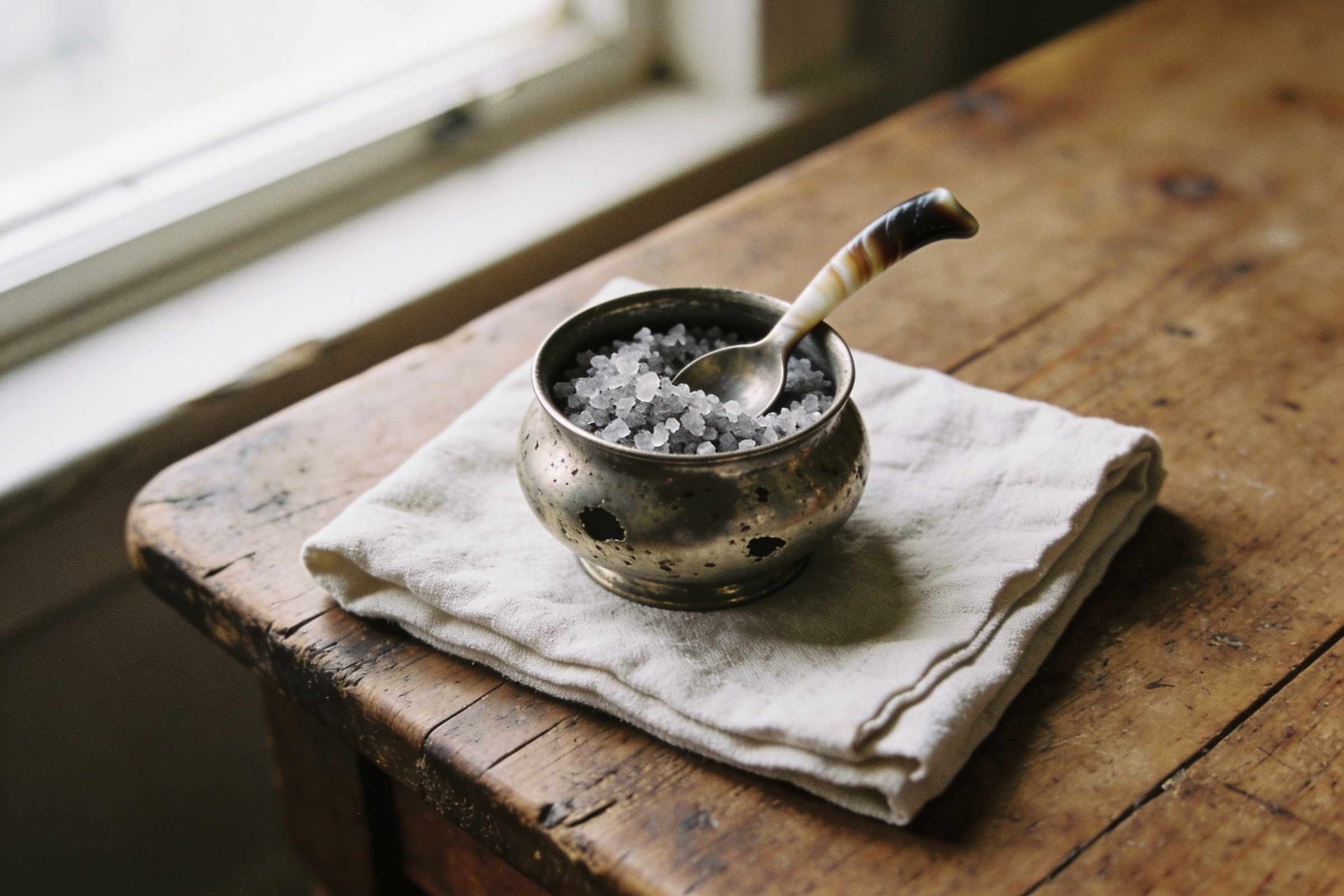
The pewter salt on my desk is about the size of an egg cup. It is dented on one side, as if someone once dropped it on a stone floor, and the inside is worn smooth and pale by two centuries of being scraped with a spoon. It cost less than a sandwich. I think it is one of the most interesting things I own.
For most of history salt was precious, and the dish that held it was treated accordingly. At a great table the salt was the centrepiece, sometimes a sculpture in silver the size of a small child, and where you sat in relation to it said everything about your rank. Important guests sat “above the salt”, near the host. Everyone else sat below it.1
From ship to shaker
The grand salts were made for show; the small ones were made for use. By the eighteenth century most households that could afford it had a pair of open salts, called trencher salts, low and heavy so they wouldn’t tip, and a tiny spoon for each, because it was bad manners to put your own knife into the common dish. Pewter, glass, wood, horn, salt-glazed stoneware: the material told you as much about the house as the table did.
A salt cellar is a small dish with a large job: to hold something valuable in the middle of the table, where everyone can reach it.
Then, in the early twentieth century, salt changed. A small amount of a drying agent stopped it clumping in the damp, and for the first time it would pour. The shaker, which had existed for a while as a curiosity, became the only thing anyone needed. Open salts went into drawers, then into boxes, then into house clearances like the one where I found mine.
Back on the table
They are coming back, slowly, with the kind of salt that won’t go through a shaker anyway: flakes, damp grey crystals, salt you pinch rather than pour. The potter Hester Lund, whose kiln is on the edge of Ollerby, now makes more salts than mugs. “People want something on the table that they touch every day,” she told me. “A salt is the smallest thing you can make that does that.”
Mine sits by the stove now, full of the grey salt from Morrow Ness. It still has the dent.
Footnotes
-
The phrase survives in English long after the furniture that gave rise to it. Whether the salt really divided tables as neatly as the saying suggests is another matter; most historians think it’s a tidy simplification of a messier habit. ↩
End of story.